
On a stage near you, Highland theatre deserves an audience …
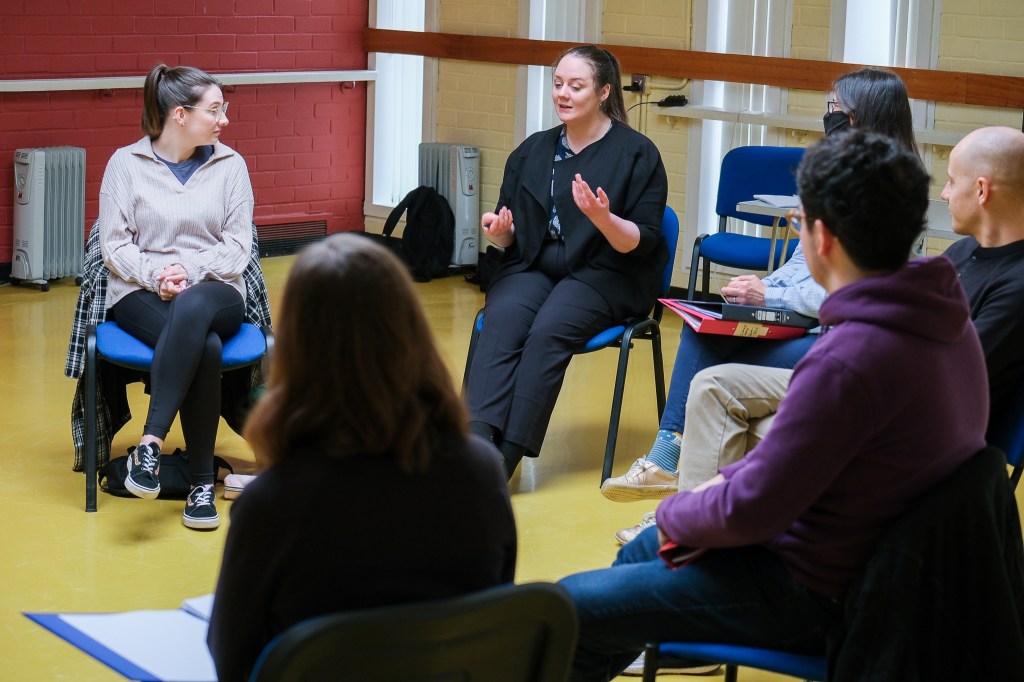
New playwright Annie MacDonald (second left), first rehearsal for The Wound, The Rag And The Inbetween. Picture: Alex Williamson
IT’S an exciting thought that over at Eden Court theatre in Inverness right now a new play is being rehearsed with a new Highland playwright and director behind it. For one night only on Saturday, May 4, the new Vivid Roots Collective will present The Wound, The Rag And The Inbetween, just one of the new productions whispered in the wind – well, snow, at first! – back in January.
That was when the first-ever playwrights’ festival Spark hinted at all the exciting new productions and talents that were coming our way this year and next.
Maybe it’s worth going back to see what happened there and then before the new year was really underway. It seemed to be a catalyst signalling a new era for Highland theatre.
So below, there’s a report created just after it – and maybe it explains why it was such an important and landmark event for what is going to follow with new theatre events this year and in 2025.
First, the new festival asked an important first question – is there such a thing as Highland theatre? …
JANUARY 2024 | Eden Court, Inverness
ON its opening night, Spark asked a packed room of young and older playwrights, actors, directors, musicians and people interested in the future of drama in the North of Scotland to think whether Highland theatre even existed.
It was something that fired up a discussion starting from a history in the Highlands and Islands to possible blueprints for the future.
Guests on the panel included Caithness poet, playwright and columnist George Gunn of the pioneering Grey Coast Theatre Company, Dolina Maclennan, the Gael, actress, writer, singer and broadcaster, Caithness actress Helen Mackay, part of a generation who fought for Higher drama in her high school, and chairman Matthew Zajac, the actor, writer and artistic director of Dogstar Theatre Company, set up in 1998 to produce, commission, tour and collaborate from near Inverness.
George Gunn’s radical and challenging view of Highland theatre was a “manifesto”, as Matthew Zajac described it afterwards.
An inspiring and challenging vision for theatremakers, his words looked at the duty of a theatre that – through oral storytelling – has been there since the Bronze Age and must, as Gunn reminded his audience, always be on the side “of those who have nothing”.
He said: “I believe that all art is people in a landscape. Without people there is no society, if there is no society there can be no art. In this Highland landscape of hills and islands, where we attempt to create our society, everything else – including our art – follows from that.”
Reminding would-be playwrights that Scottish and Highland identity – political and cultural – should be protected, Gunn invoked ideas from other writers, Spain’s Federico Lorca and Lope de Vega, Bertolt Brecht, James Joyce and poet Rob Donn MacAoidh of Strathnaver.
“Our theatre has to be able to perform anywhere at any time. It has to be flexible in form and radical in content.”
He continued: “For too long, what passes as theatre in Scotland, keeps everything questionable in our society safely in unquestioning aspic. However, theatre is a public forum where change and alternative possibilities are experimented on in public. In the theatre, our society thinks out loud. We do not make theatre for ourselves but for the audience, for the people.”
Reminding new writers of the responsibilities of creating a new Highland theatre, Gunn said: “We are blessed at being the tradition-bearers of a brilliant and robust culture. Let us use it to create a theatre with love at its core, poetry on its lips and passion on the stage… a theatre which can show us what it means to be alive, here, now, today…”
Gael Dolina Maclennan followed with a witty description of her own wide-ranging performing career which paralleled the development of Scottish and Highland theatre and began for her watching sketches by locals in her home village on Lewis. She emphasised how important community had been in embracing touring theatre in the Highlands and Islands.
Helen Mackay’s experience of developing a passion for theatre at 15 came full circle on the panel when she studied with George Gunn’s theatre company, persevering when tempted to give drama up for a ‘proper’ job with help from the playwright – literally a key to that office [“So you will never feel lost again!”]. When Helen left finally for drama college and the start of a theatre career, she told the Inverness audience he had given her a notebook and the message “Go away, come back!”.
The actress said: “For me, it is not about leaving Thurso and being an actress. We all deserve to be told stories where we live.”
How Highland theatre has developed and where it is going made a topical subject as the four days of workshops, ‘scratch’ and script sessions with actors, evening ceilidhs and daytime workshops got underway.
Three other speakout sessions looked at making a career in the theatre industry, Scotland’s theatre languages and international touring.
Matthew Zajac reminded the audience, that Scotland’s then First Minister Humza Yusuf vowed at the SNP Conference in October last year to double the government grant to Creative Scotland within five years.
And with a new generation of talented North young theatremakers facing a cost of living crisis and funds at a premium for producing and sharing new theatre, it seems a good time to start a festival like Spark.
Dogstar Theatre Company got together with Eden Court and the Playwrights’ Studio Scotland to organise the festival.
First announced last autumn, it is funded by the National Lottery through Creative Scotland’s Open Fund.
Though small, the festival’s many busy sessions over the weekend and some sellouts already make it likely the success might lead to future biennial – or possibly annual – events.
Dogstar’s artistic director Matthew Zajac explained where the idea for Spark came from.
“It was a combination of things, but I’ve been working to produce theatre in the Highlands for not far short of 40 years. It has always been a struggle as the Dogstar company has never been core-funded which made it hard for us to develop a sense of continuity between new productions and plays.
“But there have been some significant changes in the last 10 years – the drama and production degree at UHI (University of the Highlands and Islands) in Inverness; changes in working practices such as remote working during Covid that makes it less important for actors to be based in metropolitan centres, with auditions often made and sent on ‘self tapes’.”
Theatremakers, such as Dogstar’s Jessica Lusk – Spark’s producer – relocated to the North, Matthew pointed out. Eden Court appointed Susannah Armitage, originally from the Black Isle, as senior producer from the National Theatre of Scotland in 2021 before the theatre’s musical written by Morna Young, The Stamping Ground. The show, based on Runrig’s music was the start of the theatre’s new producing plans and it ran in 2022 before a revival tour last year.
Zajac said: “Though Dogstar has never had a script service for new writers, we have always received unsolicited scripts. Talking to Louise Stephens, the creative director of Playwrights’ Studio Scotland – which also receives scripts – the idea for the festival came!”
An open call for new play ideas for the scratch sessions at Spark saw the available slots easily oversubscribed.
“We expected around 15 for the eight places, but had 29 submitted! Nearly all were of a very high standard so we had to leave out some excellent proposals,” Zajac said.
After the festival, Dogstar’s artistic director said: “As an experiment, Spark has succeeded with bells on!
“We have learned some lessons – we would probably get the programme finalised earlier next time to give more time with marketing.”
But he confirmed hopes to hold Spark in future.
Two free workshops for playwrights – Right Lines’ Dave Smith on creating a play with AI and Burghead’s Morna Young [her new take on Sunset Song comes to Eden Court on May 16-18] inviting ‘silly’ questions from would-be theatre writers – proved busy.
And the final scratch session featured plays from Jack Hunter (Doing The Rounds) and Gregor Mackenzie’s Fastlane, creative and contrasting pieces of theatre. Brought to life by a small group of actors – Jimmy Yuill, Megan Macdonald and Lewie Watson – the pieces performed in front of a responsive and discerning audience drew frank and insightful comments.
“What is important as an artist is what you do next,” George Gunn had thrown out near the end of his ‘manifesto’ challenge for Highland theatre writers and playwrights.
Talk at Spark indicated there will be many plays coming this year from participants at the festival and at least one tour in 2025. Dogstar is funded to take the new play adapted by Matthew Zajac from James Robertson’s The Testament Of Gideon Mack on the road in Scotland, thanks to Creative Scotland’s touring fund.
For audiences, the festival Spark emphasised there are responsibilities for them too. Dogstar’s artistic director had an important message at the end of that first speakout session on Highland theatre.
“There is no theatre without an audience – you are Highland theatre!” MC
The Wound, The Rag And The Inbetween premieres at Eden Court, Inverness, on Saturday, May 4 at 7.30pm. Written by emerging playwright Annie MacDonald, it was commissioned to explore gender inequalities in medicine by theatre company Vivid Roots Collective. It’s a story that “reaches across the centuries” – and it features a clootie tree. More details: The Wound, the Rag, and the In-Between | Eden Court (eden-court.co.uk)
More on Spark: www.dogstartheatre.co.uk
 So impress me