
The latest Chris to fight the world
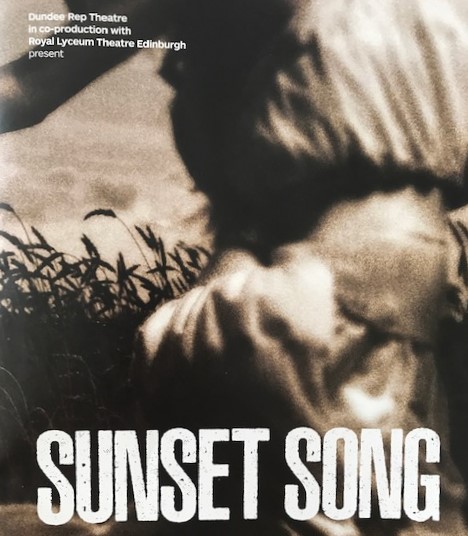
Sunset Song written by Morna Young after Lewis Grassic Gibbon
Dundee Rep Theatre and the Royal Lyceum Theatre, Edinburgh
Empire Theatre, Eden Court | Thursday, May 16
WITH costumes, music, movement, backdrop and set, this version of Sunset Song may blur the fact Lewis Grassic Gibbon’s story is set in the past.
But the text takes you back even further than the 20th century to the same place the original book does – the ancient legend of how the farmland of the Mearns and the Arbuthnott / fictional Kinraddie community formed, from Norman times.
It reminds you that the story of Chris Guthrie – her coming of age and beyond – may be set in another time and place from ours.
But also, to extend that timeline forward, what can it say about our present and future?
What does this new Sunset Song for stage from Dundee Rep and the Royal Lyceum in Edinburgh, say about today and this era, from the “two Chrises” dividing the heroine – to the land that feeds her soul through the original trilogy and the sun going down on its old ways?
The First World War strips the Kinraddie land of its trees, sold for the war effort by landlords. And maybe now in 2024 you can see parallels in the fight for the preservation of the Highland and Aberdeenshire landscape as plans to march pylons across them are justified as part of Scotland’s battle against climate change.
But such a parallel could only be made in the minds of the audiences that see the play.
This production sticks faithfully to Lewis Grassic Gibbon’s story – and ending, as the novel does – with Chris’s future hinted at, the possibilities of her destiny are open.
The plot sets the scene for a Scottish farming community at the turn of the 20th century with war coming and the Guthrie family moving from Echt to the Mearns, a teenage Chris already earmarked for an educated future, father John (a scary but emotional portrayal by Ali Craig) keen for the kudos of Chris becoming a teacher. But Chris loves the land as much as she loves her books, Rori Hawthorn makes mother Jean (weary of the stresses of childbirth) supportive of her daughter getting a chanc to experience life and the world around her.
For this production, knowing the story in advance could be an advantage, for a couple of practical reasons.
During the interval, it seemed that some members of the audience were struggling to hear what was being said from the stage at Eden Court on Thursday, though it was only the lyrics of the music that seemed unclear at times to me.
But the custom of asking an ensemble cast to play the many characters of the story had led to confusion for some of the audience – particularly the casting of “Auntie Janet”.
Yet faced with the design challenge of creating Grassic Gibbon’s Mearns, a landscape that comes alive in the book, director Finn den Hertog and the team of lighting, set and costume designers, and music and movement team, had pulled out many stops to try to take us there. Different lighting for night and day and different seasons, timeless, half-sung stories of the past at the start of the play, the staccato ensemble choreography suggesting the work of farming, the heartbeat and mood-setting of music by the cast band to punctuate the action, the wall-bars at the back and place-setting props, all contributed.
The wooden flooring, suggesting land, farm fields, seed drills and ‘earth’ between for characters to lift and let fall, gave a sense of place. For me, the backdrop – a full-size depiction of vertical lines of warm colours – was scene-setting, useful for a tour and well-used.
But with so many potential multi-media options available today since the last staging of Sunset Song by Prime Productions in the early 2000s, would that approach be one step too far? Possibly.
“Nothing but the land abides”, the lines remind us. But Chris does. Rightly, this version of the play is the chance to look again at the charismatic character of Chris Guthrie, through the perspective of playwright Morna Young, originally from the North East of Scotland.
She writes movingly in the programme about her own experience of finding truth in the 1932 novel, heading for university, speaking Scots and English and being a teenager navigating her way through … complex feelings about the two identities that seemed to be pulling me in different directions”.
Before writing this version, the playwright shares that no previous version of the stage and screen adaptations “had been authored by a woman”.
Actress Danielle Jam – “a fellow north east quine” the playwright reminds us - brings energy and a trusting innocence to her portrayal of a heroine who seems anachronistically modern in her reading of life.
The play sent me back to Cloud Howe and Grey Granite to see how writer Leslie Mitchell originally foresaw Chris’s life in the final two parts of his A Scots Quair trilogy written as Lewis Grassic Gibbon.
But watching Sunset Song played out before you on a stage, a 2024 audience is forced to wonder, could Chris’s story – her own struggle to resolve conflicts and make two Chrises one – be so different today? MC
 So impress me