
Peter Noble’s sounds of time travel

by Margaret Chrystall
When Peter Noble tells you his latest album is going for time travel, maybe his experiment is one you should have predicted.
And possibly it was an inevitable next step on a journey capturing environments in sound that began for musician Peter in the run-up to lockdown.
Trying to capture the sounds of the Cromarty Firth in the project, he made album Walking North – inspired by a book by Japanese poet Basho, The Narrow Road To The Deep North. Peter carried a metronome to help walk to the beat as he ventured to places around the Cromarty Firth. And he used the recordings from that environment as an instrument he could mix in with his songs, with other instruments.
After that, other albums followed – both in 2022: The Lee Of The Wind (the wind in different significant trees around the area); Following The Water’s Flow (water from rain, river and sea to paddling a canoe).
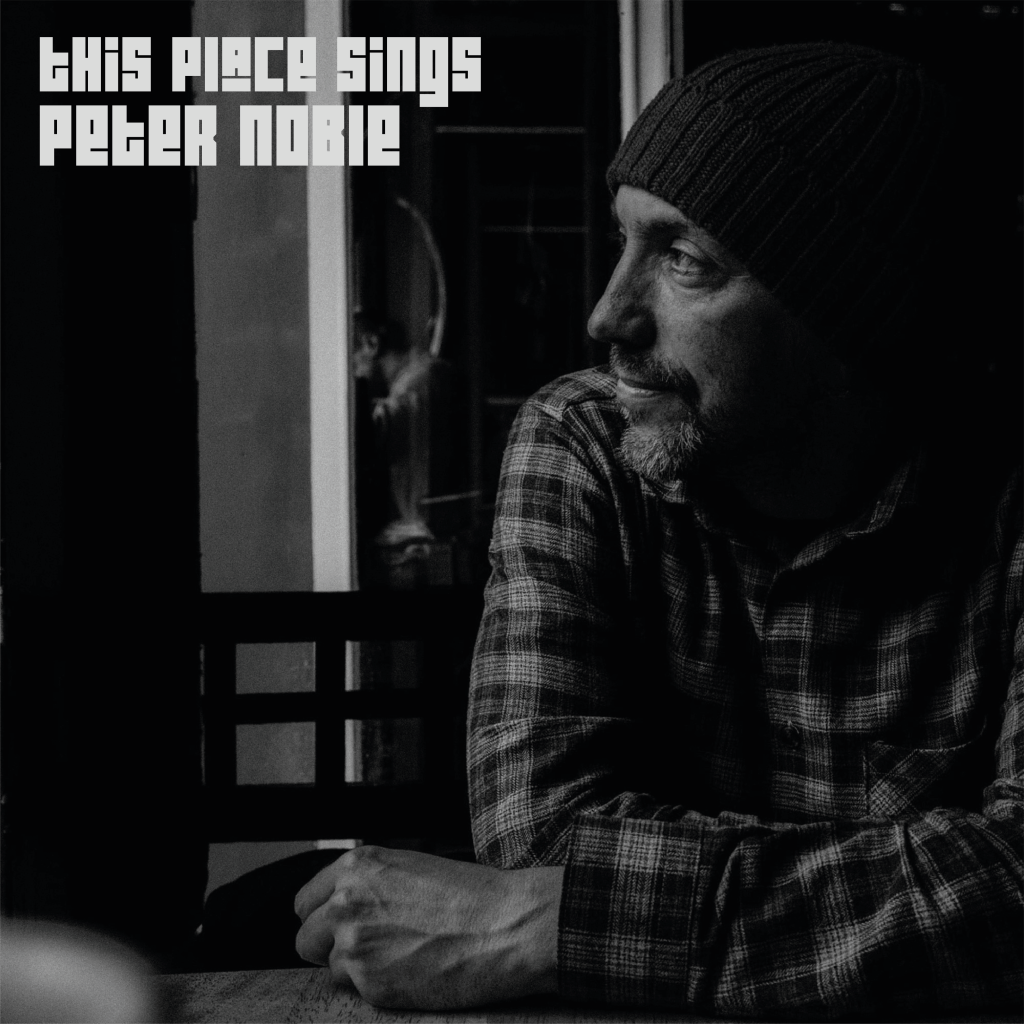
The Stuff Of Life in 2023 had songs with everyday sounds from washing dishes to Peter talking to his dad. And in May this year, the next stage saw Peter recording places themselves in This Place Sings – including a railway station, a rain-lashed car on Berriedale Braes and a wind farm.
As usual, with the rigour of a man of science – you can sometimes almost imagine a white lab coat! – Peter assesses the success of the ideas behind the tracks of the album.
“Each time I’ve done one of these – I don’t know whether to call them albums or experiments – I’ve learned things about the process. And in some ways I’ve refined it and in some ways I have taken a tangent.
“But what I normally find is within one is a glimpse of what I will do next!
“I guess it’s just cycles of creative experiments that I’ve learned from. Within them all there are moments that I really love!”
Listening to them all through, maybe you could have guessed about time travel …
The power of the past and the flow of time has already come up in earlier albums. In Walking North (2021), Footsteps On The Ground, recorded at Nigg beach, listen and you can faintly hear his children. And in Following The Water’s Flow (2022), the track Time Like A River Does Nothing But Flow finds Peter thinking about the ‘flow’ of events. He sings: “Time like water passes through my hands.”
Asking about the atmospheric track Broch, Peter tells you: “My most ambitious idea is on that track – where I attempt to create the illusion of time travel!
“My intention was that I went to the broch just above Dunrobin Castle.
“I started off recording, just me making a noise, but none of that worked, so then I started speaking about what I could see – and that was OK – but I hadn’t really thought about what I was going to say, so I wasn’t sure what I was going to do with it.
“Then I was talking to somebody about early recording methods – they used to have a trumpet funnel and a needle going onto a bit of tin foil or thin metal sheet, and that would be how you would create a recording. But it’s rubbish because it’s so faint you can’t hear it!
“But I had the idea, what if I tried to make the sound of an ancient recording? I imagined making my voice drift back and sound like an older and older recording, as if it was 10,000 years ago!
“Of course that couldn’t happen,” Peter laughed. “But how would it sound? Through the song, what I attempted to do was make it feel as if that voice was distant and it would drift back through time and then come back to the present day.”
Peter then mixed in the sound he had made originally at the broch to make it sound as if what you were hearing was moving back and forward through time.
Listening to it, it’s a slightly eerie experience. You have to tune your ears to what – in my imagination – becomes the gruff voice of an ancient man from long-past times lingering in the broch and the voice describing the location. Peter’s song gradually brings you back into a contemporary environment – last words: “Time-travelling, by being still.”
Peter explained: “In the idea of capturing an environment was a Japanese project, the ‘100 sounds of nature’ or ‘100 sounds of an island. They captured the 100 environmental sounds that were distinctive for a lot of Japan and preserved them and not all of those sounds recorded exist any more
“We don’t do that with sounds!
“We do it with pictures and landscapes and appreciate them, but sounds are just as much part of our environment.
“There is something in the fact these are moments that are captured.
“Going back to my first or second experiment, the track I recorded at Nigg for album Walking North – Footsteps On The Ground – you can just hear my children playing on the beach.
“Obviously, for me now, that was four years ago. Now my children are older. So whenever I hear that, it’s just a weird moment where I remember it vividly.
“I’ve captured something specific in that moment of time.
“I think there is an element – because of the way I’m working – that I’m capturing something that is specific to the moment in time.”
Starting off his ideas for the latest album This Place Sings – including the striking sound of people humming in a stairwell, a meeting where he uses recording techniques he later found PJ Harvey has also been experimenting with on her latest album, and capturing a river soundscape that may not be here in the future – Peter mentions an influence.
“As you know I usually have a book I’m reading. This time it was David G Haskell’s Sounds Wild And Broken and he is talking about the sound of home environments, sounds and soundscapes. He has some lovely ideas and one of them is that animals will find their own place in a soundscape – some will sing higher and others lower because they want to define that area for themselves.
“I loved that idea of a whole environment singing. And nature fits around manmade sounds that are equally part of the environment.
“One of the things David Haskell goes on to say is, when they do environmental assessments of areas, they used to have people walk through a forest, and tick off all the sounds.
“But now what they do is they put recording devices in there and they use AI and it very quickly identities all the frequencies that are different – basically all the animals and birds – and it quickly tells you how many are in that area and the density.
“It’s an amazing way of capturing the whole environment in a scientific way.
“I was wondering if you could do that in a creative way and if it were possible to make it feel as if the song and the music accompaniment were playing WITH the environment, that was what I was trying to get to.”
“Another thing the book talks about is how these environments are changing and what is happening to the world with global warming.
“There are sounds that we hear now in the way that we live that won’t be here in 10 years, so there’s also something in this about preservation.
“There are things we hear in the garden that are local to us and that we almost take for granted in that soundscape because they are there.
“But for us all, it changes over our lifetimes and it will continue to change, so I thought it was a fascinating way of thinking about it. “The ‘voices’ of these individual things are part of the landscape of our lives and do we notice if they’re gone?
“I wonder if we are aware of it if we are not really focused on it?
“Part of me thinks we might be – we are aware that something’s changed.”
On latest album This Place Sings, the sounds of the places themselves and how Peter decided to record them, play their part on the different tracks.
He said: “The first place I thought of was a campsite. I was at the Glenmore Campsite [in Aviemore] four years ago and woke up really early and it was just ridiculous, the variety of languages and of noises – someone snoring, someone cooking, someone getting up, someone leaving – it was bonkers!”
Other ideas came quickly …
“The train station was an obvious one after that because that is a very specific sound, that environment.”
Peter, who is arts curriculum leader for creative arts at UHI North, West and Hebrides, turned to that for track The Big Meeting.
“We had a meeting in September with a load of students, so I thought of the interesting sounds that could be – all of us for the first time.”
“In By The River, what I was trying to do was demonstrate the idea that if you go into different frequencies of the landscape, you hear different things. That track has a frequency sweep with the sounds of the landscape slowly changing what you hear as I sing the song.”
Running parallel with his last two album experiments, Peter has been performing the work going back to songs from the beginning.
He and guitarist Liam Ross played tracks from the albums – with fun audience participation – at The Field in Alness in August 22, as part of the Dandelion Festival.
And in September last year – after winning funding from Creative Scotland to work with different groups across the area, their input part of the performance – there was a show at the Spectrum Centre in Inverness, including online participants.
At the time, Peter looked back to first album Walking North and the upcoming show, and recalled: “I remember talking after the first work I had done, the recordings of me walking, and I remember you asked ‘How would you perform it?’ and said ‘You could go to the locations!’. I was interested in creating a performance where it felt that you were transported to the locations.”

Sadly, bad weather and a weak internet signal on a Greek island holiday compromised my own chance to join in with the Spectrum performance last year!
But there is possibly another show before the end of this year, Peter hints.
There is also a chance to hear Peter when he performs at Belladrum’s Burke n Hair stage on July 26 and 27.
Earlier, Peter hinted that – as usual – putting an album together and recording for it in his experiments, gives clues about what comes next.
“What I’ve seen happen is in Invergordon they are knocking down an oil tank in the middle of the town and I had a song about a tree that was in there and obviously it’s gone. And there are a few locations like that that are completely gone now – my children’s primary school got burned down and that is completely flattened.
“I want to bring them back to life through song, but we will see.”
The next stage of time travel? Restoring the lost …
Peter said: “Over the summer I’m going to try and find spaces and I’m excited about it.
“I think I’ve got the next idea!”
He admits, being critical, that some ideas didn’t end up as he expected. “There are things that I don’t think have worked at all, but I’m kind of OK with that.
“I feel like I’m getting somewhere.
“But I don’t feel I’ve got there yet..!”
+ You can buy the new album This Place Sings and the earlier ones too, on Peter Noble’s Bandcamp (https://peternoble.bandcamp.com). You can also listen to them on Spotify. Catch Peter performing at the Belladrum Tartan Heart Festival’s Burke n Hair stage in the Walled Garden on Friday, July 26 and Saturday, July 27 at 7:30pm (just before Hugh Reed and the Velvet Underpants!). The book Peter refers to is David George Haskell’s Sounds Wild And Broken (Penguin). Also mentioned is Matsuo Basho’s The Narrow Road To The Far North (Penguin Classics). You can follow Peter on X (Twitter): @peterjnoble1
 So impress me