
Laura Walker: ‘We’re … at this really exciting stage where we’re about to really change up our model for how we make work’
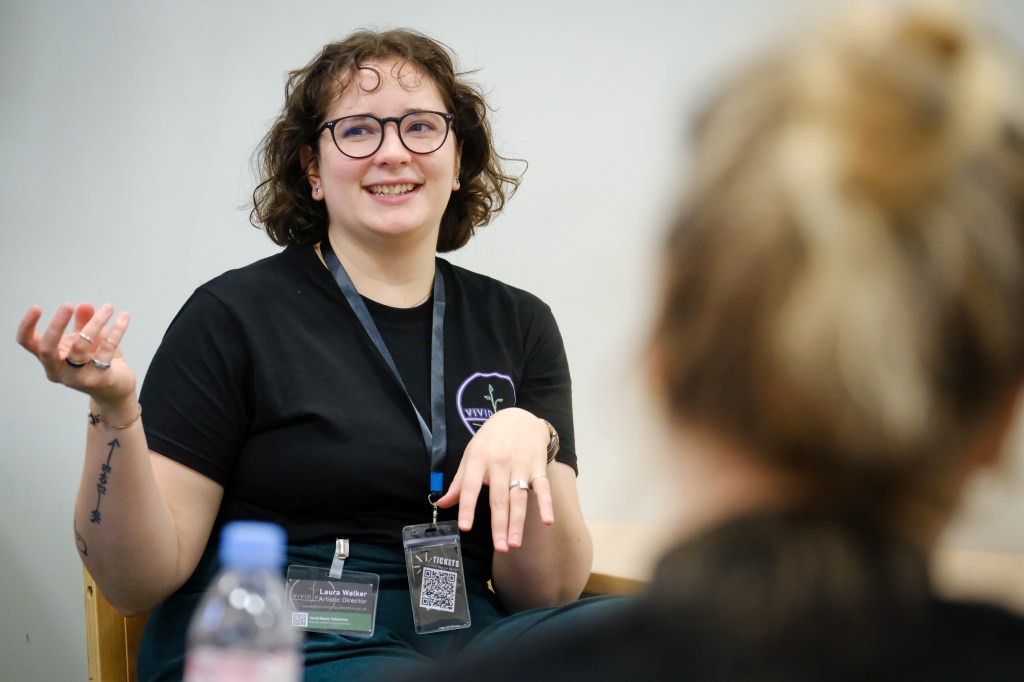
Vivid Roots Collective’s CEO and creative director Laura Walker talks about stage productions past and future, Highland theatre and festival Roots 24. Picture: Alexander Williamson
Questions by Margaret Chrystall
QUESTION
1 Looking back to May and with the time to mull it all over since, how did it feel to stage at Eden Court’s OneTouch theatre the premiere of Vivid Roots’ original production The Wound, The Rag And The Inbetween for yourself, both personally, and as the producer?
LAURA: It’s funny because I think as the producer, the production had been happening for years and we’d just been working towards it. And I think sometimes it feels kind of surreal that it’s something that we did, but I actually think for the most part it just feels really normal and it feels really right that we developed the idea probably back in late 20/21 and then we went through the stages of developing that idea and developing a brief and getting funding to commission the writer and do research and development, and then produced the play.
That all sounds really obvious.
But I think there’s a lot of fear involved for sure, especially when it was our first production and just not knowing if we were going to get the funding.
And I think, as a producer, you have to do a lot of the learning for yourself.
I’m lucky that I’ve got a really amazing support network of people who are at the same career stage as me, but also some amazing producers who I can go to to ask for help if I need it.
Often it’s just having people around you who can affirm what you are doing and make you feel that it is OK that we don’t always have the answers, but that actually getting to Eden Court and doing the production – it’s what we set out to do in the first place.
I think, more than anything, I did feel really emotional hearing the applause from the audience [the show had just one performance] because I’ve been in the OneTouch very often as an audience member.
I love that space and I just think, you know, it’s one of my favourite theatre spaces that I’ve ever been in.
And I think it was a real treat for it to be so full and hearing the sound of an audience applauding at the end of a show with real passion.
People were really moved by the show.
I think that’s enhanced by the fact that they know it’s born out of locals and local stories and histories and that really shone through.
But so many of our audience members hung around and I think that was the part that was really emotional, knowing that it was valued and I think, as well, not even just the play.
It was also that people really resonated with the work that we’re doing as a company because it wasn’t just about the show, it was also people really wanting to see more of the work and to see more local artists supported by it.
So that was very special.
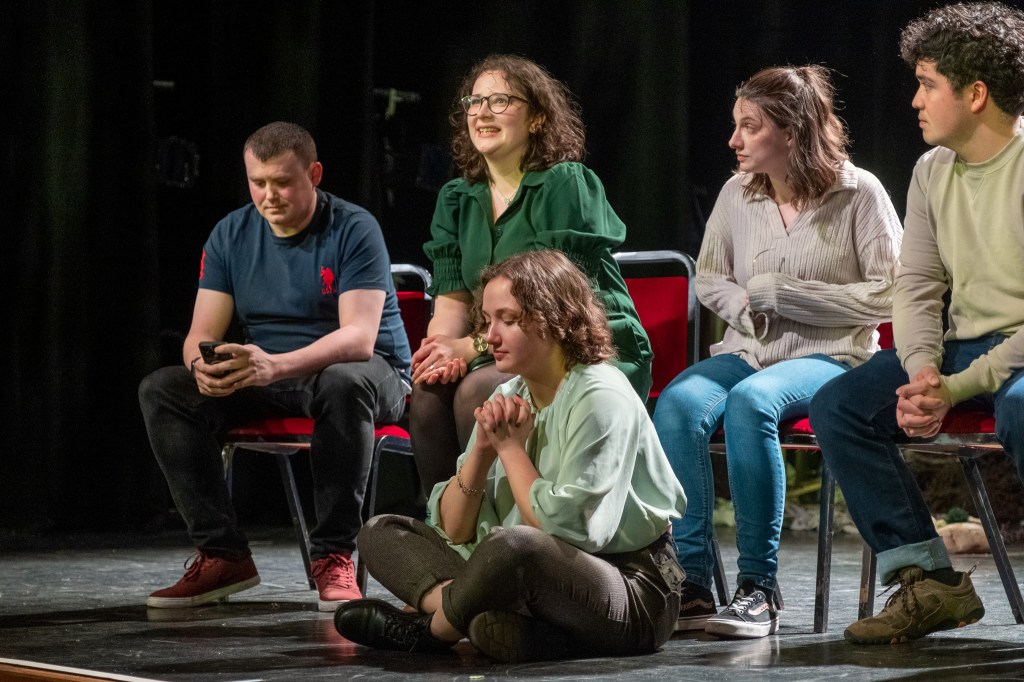
Laura (second left) in the Q&A with the audience, creatives and cast of The Wound, The Rag And The Inbetween at the OneTouch after Vivid Roots’ production of Annie MacDonald’s premiering play. Picture: Alexander Williamson
QUESTION
2 As the Vivid Roots Collective’s first production – did it feel like a huge milestone and did it inspire a ‘what’s next?’ mood – or something more measured, like a stocktake of where the group had been and where it might be wanting to head next?
And did anything change from what ‘next’ might be once the night had been created and performed?
LAURA: As a first production, it totally was a huge milestone! I think the most important thing is we are a relatively new company, but we’re also all early career makers, so you just have to do the thing. If you’ve got an idea for something you just find a way to do it.
And then you know that you can and it makes everything after that feel a lot more possible.
I think we’re always in a ‘what next’ thought, actually. So after the production, I think we were all in a lot of big reflection time.
I think there’s a huge emotional process and potentially a grieving process that we go through when we finish a production and there’s been years of work – and I think it’s also a lot of emotional work – to really invest so much time in something that you really love, that you’re not sure if it’s going to be successful. I don’t know how much that changes as you kind of grow into the industry.
But, yeah, it’s a very vulnerable and really huge process once the production’s over to process all of that emotion and the learning and to kind of move on to the next thing, I think.
In some ways, I was kind of saved by the fact that we got funding for a second Roots theatre festival [which begins on Wednesday (October 16), details below], so we’ve been working on that and it gave me a focus.
I think often as a company we’re in a process or stage of “What’s next?”.
Reflection and evaluation is a huge part of all the work that we do, so any time we finish a big project – and at the end of the year – we do commit time to just looking back and seeing what we can learn.
I think the big takeaway at this stage is that we really want to change how we produce work in the future. We did Hysteria [a read performance in January last year], born from the company, and then we went through the stages of creating a brief for that and applying for funding to commission artists and you do your research and development – and then the play!
I think in future we’d like to create opportunities for local and emerging theatre-makers to create the work that they want to make, rather than us imposing a kind of theme or style on them.
I think we’re at a stage where we’re looking to kind of grow our reach.
And I guess your next question is about that…
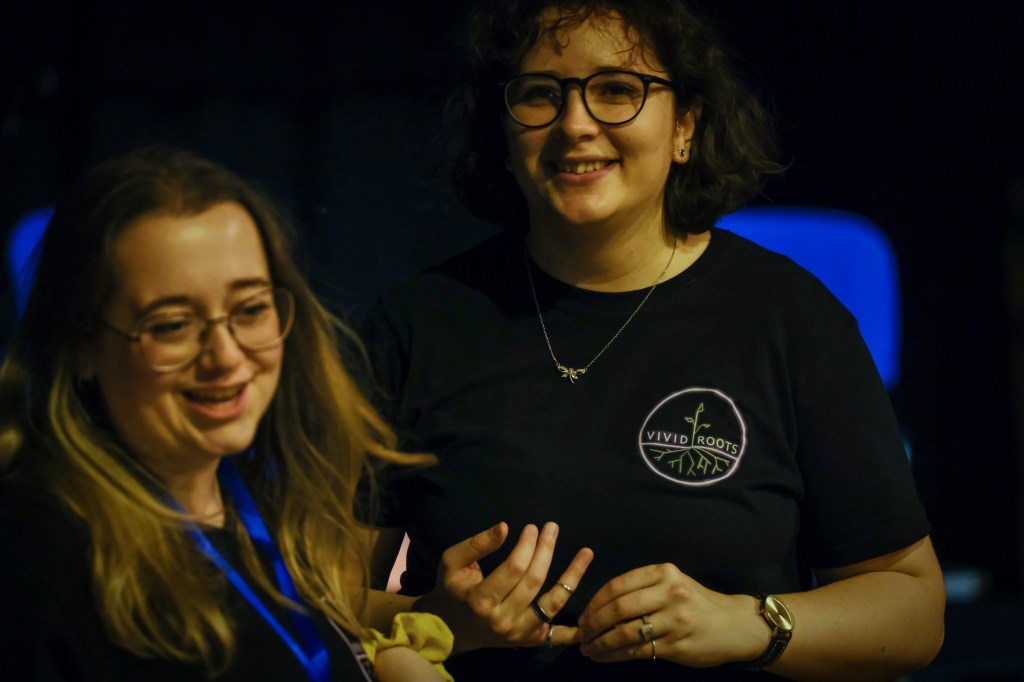
During last year’s Roots 23 festival. Picture: Alexander Williamson
QUESTION
3 You have a continuing programme of events for fostering new Highland talent and a clear feeling of fostering a Highland theatre, including working with a group of theatre-makers from Inverness and Kyle planned for this year?
Unfortunately we’re not going to be able to host the Kyle and Budding Collective this year.
But we’re hoping to work with them next year with a little bit of time to warm up and invest In the local community more.
We do want to be more outward looking and want to be improving our reach across the Highlands because we do see ourselves as becoming a Highland-based and not just an Inverness-based organisation, that’s really important to us. But it does just take time.
The next thing is our second annual roots festival in a few days and The Budding Collective are going to be performing at that.
Last year we just did two in-person days because it was our first festival and we wanted to make the event as easy as possible to deliver.
But this year we are holding a hybrid event with three days of online workshops and panels leading up to a one-day in-person summit on Saturday which has performances by local or Highland-based theatre-makers.
That’s a combination of The Budding Collective performance, a performance by Catherine MacNeil and Stephanie Reffert and performances by our scratch artists who have been recruited through an open call – so that’s really exciting!
Last year when we did performances, we did some graduate performances and the scratch night.
The scratch night was so well-received and people really enjoyed it. We had lots of positive feedback about it, so we’re excited to bring that back this year, but kind of moving into this realm where we’re wanting to support local artists and engage with local artists more and support the work that they’ve got in development.
We have been announcing more about who the scratch artists are and what their performances are looking like as we have got closer to the festival because they were still in development. [See more details in the separate preview guide and the ticket website with Saturday’s line-up].
QUESTION
4 I know that you had funding from the National Lottery via Creative Scotland and support from Eden Court for The Wound, The Rag And The Inbetween … How much of a difference did it make to have that financial support, in particular. And is it something you would need to seek again to make a full production or other events viable? And, for outsiders who maybe don’t know, what does that involve? How much time and effort does it take to try and get that support? And how easy is it to find it – and Highland business sponsorship – for an emerging company like Vivid Roots Collective?
LAURA: We can’t do the work that we do without funding and we are working on our own income generation strategies. But as a theatre company, I don’t know anyone that’s really cracked being able to do that.
I know people that can do it on a really small scale.
If you’ve got a one or two-person touring show that can just rock up to venues, with a couple of props and you can all fit in a car and just drive away again. I know people who do that very successfully.
But at the kind of scale that we’re wanting to make theatre – which is very much mid-scale, small to mid – then it’s really difficult to do that sustainably – financially, at least. So funding is a huge part of making theatre and Scottish theatre wouldn’t really exist as it is without funding.
And we also get a lot of support. Not just from Eden Court, but Eden Court has supported us by letting us be in the OneTouch theatre for our whole production week, which is really special and they’re a really amazing organisation. I think Rebecca Holt [the chief executive of Eden Court] is doing some exciting work around supporting the local theatre community – the Highland theatre community – more.
I lived in the Highlands at the very end of former Eden Court director/ CEO Colin Marr’s time at the theatre which was then followed, drawing James Mackenzie Blackman here and now Rebecca Holt.
And it’s been really interesting seeing those different eras of the organisation and I’m really excited by the direction it’s been moving in and now under Rebecca’s leadership.
It feels really in line with a lot of the values that we have as a company and they are always willing to support us, often through ‘in kind’ space or even for the festival.
This year we’ve got a couple of days of ‘in kind’ space for our scratch and budding collective artists to use as rehearsal space ahead of their performances at the festival.
We’re also, many of us, individual members of the Eden Court Connect. It’s a really amazing scheme where we have some networking events and can access a lot of different kinds of support through Eden Court.
And we also had ‘in kind’ support from Lyth Art Centre in Caithness for the original research and development of the production of The Wound, The Rag And The Inbetween.
We’ve been in the throes of looking for sponsorship and undertaking a crowdfunding campaign for this year’s festival, and we’ve done sponsorship and crowdfunding in the past, so we’ve been building on last year’s sponsorship and success and when we did our first-ever project in September 2021- which now feels like 100 years ago! That was fully crowdfunded.
We did put in an application which was rejected, so we crowdfunded the work that we wanted to do and we managed to bring in some theatre-makers to work with us on a guaranteed fee with a profit share and definitely not on the rates that we would pay now. But we were really proud of that work.
And again, it was just that really important first thing that we needed to do to be able to move on to the work that we do now.
So yeah, we’re, kind of looking for crowdfunding support again this year.
I think that for sponsorship, we’re still in the really early stages of it, but it is about relationships. Those who sponsored us last year were Rendezvous Cafe and the tournament shop, which is in the Victorian Market.
They came from conversations and we try and reach as many people as we can for sponsorship.
You do it in the hope that these are relationships that can grow in the future.
I don’t necessarily know if it ever gets easier, but some relationships are really fruitful and could continue to be. But we also never know what’s going to impact the business community and how that might change things.
For crowdfunding, I think when we did our first event, we were really relying on the excitement and the passion and the support from our friends and family. And so it’ll be interesting to see if people are willing to support us still.
But I’m very confident that we can bring in that kind of excitement.
I think it’s maybe hard in the creative sector because it’s been quite a difficult couple of months with the Creative Scotland decision to close the Open Fund for individuals and then the aftermath that’s followed it – and it’s post Edinburgh Fringe.
I get the feeling people were a little bit burnt out, but over the last month or so, they have started to revive.
We’re definitely excited in the lead up to the festival.
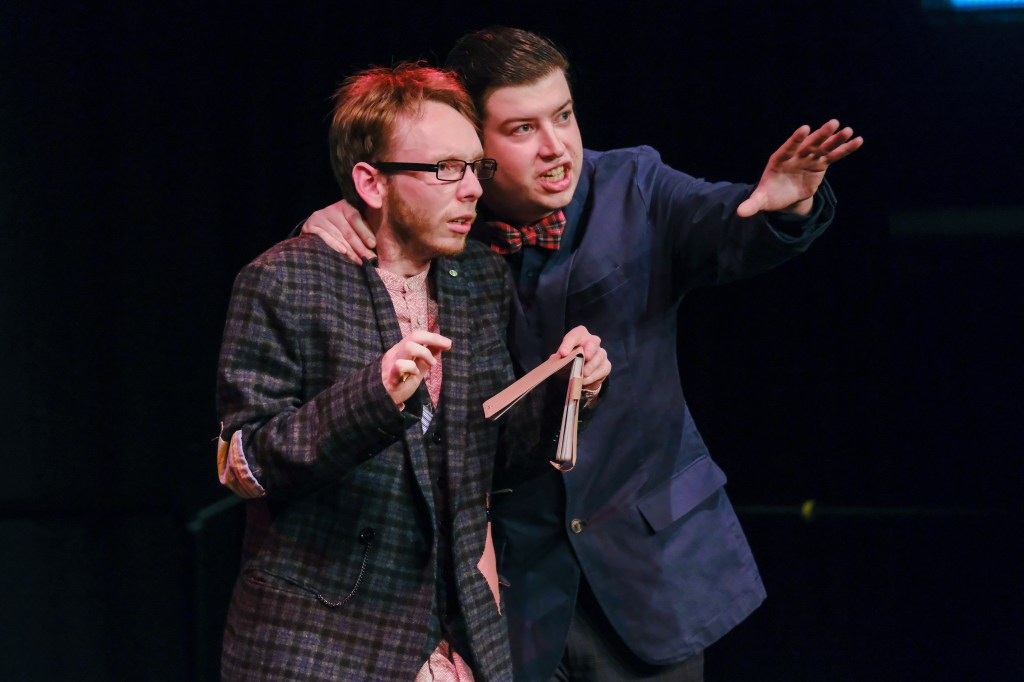
A moment from one of last year’s Roots 23 festival performances. Picture: Alexander Williamson
QUESTION
5 I find myself wondering what it is like to be thinking about your plans with the new government to consider? Is it a change that you view optimistically or will it mean a period of watching them finding their feet that will impact companies like yourselves? [Events with the Scottish Government and Creative Scotland have continued to unfold since this question was asked!]
LAURA: I think that we have to be aware of how the political world impacts culture. We’ve seen a really direct impact with the UK Government withdrawing funding to the Scottish Government and the Scottish Government really taking their time to announce funding for Creative Scotland and that has a huge impact on our industry.
And I think, we’re coming into a really big change with hopefully multi-year decisions being made at the end of October. So I think at the moment we’re kind of lucky in a way that we didn’t apply for the multi-year funds because we were too young. We just don’t have the infrastructure to be able to provide the information that Creative Scotland would need to fund us. So it does mean that we’re not having to wait for that decision.
And we are continuing to make work, but it’s going to be really difficult – and towards the end of the year – then you know in future. But I think the industry always changes and funding is always going to change. And I think if we want to thrive, we do have to be adaptable and be engaged.
QUESTION
6 To go back to Vivid Roots’ production of The Wound, The Rag And The Inbetween in May. There seemed to be a lot of hope from your audience after that first public performance at Eden Court that the production might be seen elsewhere and maybe also across the Highlands in future. Have there been any plans about that – or is it something that might happen in future?
LAURA: We’re not going to be touring The Wound, The Rag And The Inbetween … and the really simple reason for that is that we don’t have enough experience yet as a company to tour the work. And that’s the logical next step for the show.
It doesn’t necessarily mean ‘never’. I mean, you know, we commissioned Annie to write that play, and it was a full play commission, so that play exists and it’s a very beautiful play.
But yeah, for us right now we’re focusing on new projects and our festival. And really embedding ourselves and building on our strategy?
Hopefully in the future we’ll be able to tour work and we’ll have a strong enough background and reputation to lean on, to be able to get funding to bring theatre to other parts of the Highlands and Scotland.
For now, this is like the end of this current path for The Wound, The Rag And The Inbetween with Vivid Roots Collective and I think that it’s so funny because of the kind of passion from the audience of wanting to see more and conversations that I’ve had with others since then. People think it’s a real shame and, you know, in some ways it totally is.
But I also think it’s some of the joy of theatre that it’s not filmed. It’s something to make a difference to the people who see it and often to the people who work on it and that shapes them a little bit.
I use the word ‘ephemeral’ a lot.
I love the word ephemeral, but it is ephemeral, something that just exists then and there. Even if you do watch a recording of a play, it’s not the same as watching in a room full of people and that’s something that’s really special and important about theatre.
So, yeah, I’d love more people to see the play and see the work that went into it by everyone.
But it was also about the artists and I think mostly about the artists. This was the first production by us.
It was my first production as an early career producer and for a lot of the core creative team and the production team.
It was a first full production, so it was a lot about the learning experience and the opportunity for the artists involved, rather than the work itself.
I mean, those things always come hand in hand, but that’s what that was there for – to give everyone the experience of doing it, so that the next time we produce a show or Annie MacDonald writes in theatre, or Keira Smith [co-founder, playwright and lead artist. They directed The Wound …] directs a play, we’ve got that experience to rely on.
And our ongoing plans are exciting.
QUESTION
7 What are your current ongoing plans for Vivid Roots’ productions?
LAURA: We currently are in the process of revisiting an application which is something that we’ve been talking about for a while and has definitely had a long life. It’s been a slower burn than Hysteria, for example, because it involves a lot of partnership working.
We’re currently working on a project called Rewild which we are doing in partnership with some really important organisations in the north of Scotland and it’s about the sort of relationship to the environment for people in the Highlands.
There were some conversations with organisations and individuals who work in theatre and arts in the north of Scotland maybe a year ago now.
There was a feeling that there were a lot of environmental policies that were kind of built for urban environments that didn’t suit Highland and rural working. Things like – we actually just need to drive because there isn’t a bus! And even down to things like how we get food. Huge supermarkets have really changed the local food economy. You know you can’t just pop down to the grocery store like people used to. That means people have to travel quite far for a supermarket, whereas in the past you would probably have had a local grocer.
If you live in a city then you’ve probably got the option of 10 stores in walking distance of your home.
The brief was inspired by these conversations, looking at how our relationship to the environment is potentially different to people’s relationship with the environment in urban areas. But, yeah, that will take on a really different form once we bring it to research and development. So that’s our next project that we’re working on an application for just now.
We’ve obviously got our festival coming up, this time supporting more emerging theatre or local theatre-makers to create their own work.
And we are also about engaging with more organisations across the Highlands in different communities. We’ve got some really big work planned for the next year and that I probably can’t say any more on because it will rely on us getting some funding!
But I think we’re kind of at this really exciting stage where we’re about to really change up our model for how we make work.
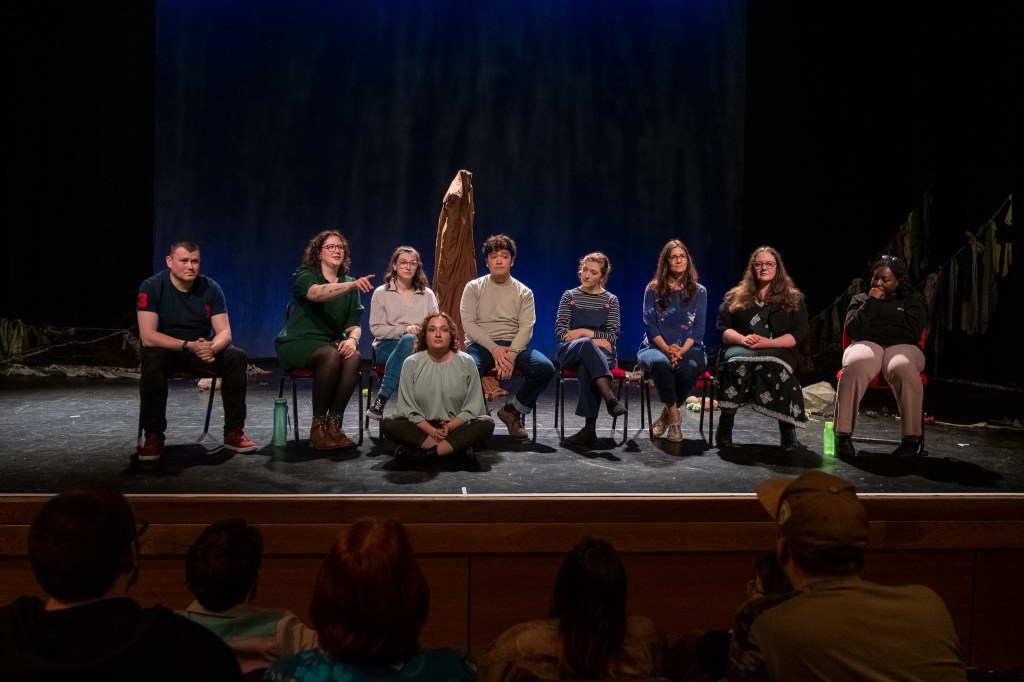
Laura (second left) talks to the audience in the Q&A after The Wound … performance back in May. Picture: Alexander Williamson
QUESTION
9 And I wondered if there had been things on a personal basis as a director and producer working in the Highlands and the North that had been absorbing your attention lately – or coming up?
LAURA: I’ve been working as an assistant producer on the Findhorn Bay Festival this year, which has been really exciting with some amazing shows on and that’s been a huge, huge task.
I’m also working on a project with Grampian Hospitals Art Trust. I’m starting conversations with communities in rural areas about arts in healthcare. And then I’m always trying to make my own work and that’s been really difficult.
I had three funding applications, not just through me, but through me and other artists that we were expecting to go in September, but we only managed to get two in before the deadline.
That was really emotional and really difficult. And I think a lot of us, as in me and my peers, are kind of in a place where we’re really not sure what the future looks like for us. For my part, as an individual, as a freelancer, I’m also thinking if my practice looks like it might be better suited for the current model for arts funding. Both as a director and a producer, I really rely on those opportunities.
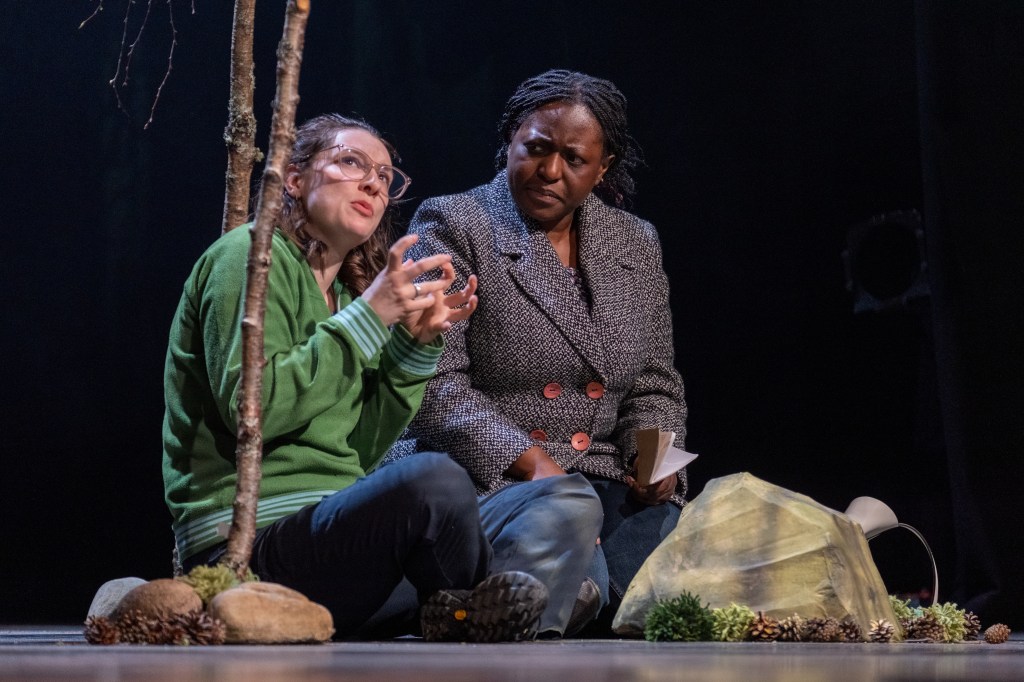
A scene from The Wound … from Vivid Roots’ production. Laura: ‘ I think our values are really rooted in care and ambition and learning and community’. Picture: Alexander Williamson
QUESTION
10 Finally, I think there is probably more to ask about the objectives and hopes of Vivid Roots, including your openness as decision-makers – and wanting to attract decision-makers – in this phrase in your paragraph about yourselves on the VRC website, as: “.. a mixture of queer and straight cisgender women but we would like to connect with artists and administrators in the theatre industry who represent the global majority (POC); non- or semi-British ethnicities; marginalised genders; single parents; neurodiverse; or disabled.”.
I wonder if that sets you apart from most emerging theatre companies? But for Vivid Roots is it simply the best and only and most open way to progress things in the world as it is and how you want it to be, here and now and in the future – being inclusive?
LAURA: On our website, we’ve got sort of an open invitation for people to be in touch for decision-making because the core of the Vivid Roots team on our board are not representative of all different ‘intersectionalities’ in our world and we are aware of how our bias impacts our decision-making process. I think all of us who co-founded the company are really committed to better accessibility in the industry and so we’re really thoughtful about how we make decisions.
But I think it’s still better where if we have a lot of artists who tell us that they’re neurodiverse, for example, that we have someone on the board, on the decision-making panel, who can support us when we are making decisions.
Obviously, we’re not asking for any decision-maker to be entirely representative of, like a whole demographic of people, but just someone who can support us making decisions that aren’t discriminating against anyone subconsciously.
And I think that’s really born from wanting to create and wanting to make sure that artists in the Highlands have got better access to opportunities.
So I think as soon as you’re looking at accessibility in one area, then you have to be looking at that in all areas.
I think our values are really rooted in care and ambition and learning and community and we have to be open and accessible in all the work that we do.
We are not doing that perfectly! But we do try hard and we do – at each project review – ask for feedback from everyone who works with us or attends our events and we do implement recommendations on the next project.
I think that’s important for all of us.
We just want to live in a world that’s more open and accessible and generous and kind. I think that because the co founders and myself – as the CEO – live in those values, and they inevitably show up in the way that we want to work as an organisation.
Thanks to Laura Walker for her time in answering these questions. Also thanks to photographer Alexander Williamson (www.alexander-williamson.com). For more on The Roots Theatre Festival (Wednesday, October 16-Saturday, October 19), go to: https://vividrootscollective.co.uk/
You can get tickets, from £5 and also paying what you can afford: https://events.humanitix.com/host/vivid-roots-collective
 So impress me