

Inverness writer Hamish McDonald … research about grandad after 1917 faded photo found.
by Margaret Chrystall
Football poet Hamish McDonald launches his new book in Inverness on Wednesday, (Oct 29) and shares the story of his mission to solve the mystery of his footballing grandfather’s First World War.
Writer Hamish, a long-time Clydebank FC fan who was brought up there, had already been invited by the club to become Bankies Bard and wrote a football poetry collection specifically for Clydebank called Kilbowie Dreams in 2020.
“I had in mind to write another poetry collection on the broader aspects of Scottish football and I had delved into the story of my grandfather William McKenzie Grant’s playing days and had written a couple of poems about him.
“But he was a wee bit of an enigma. His First World War record was quite limited and I wasn’t sure what had happened to him because – like most men of his generation – what he told my mother about the First World War was guarded and cautious.
“There was also a family story about him coming home at one point, stopping at Carlisle and having trauma. So I knew that, like all men on the Western Front, he had suffered trauma.
“But as a result of not having a complete picture of his wartime journey, I didn’t feel I wanted to second guess it.
“All we knew was that he had enlisted at the outbreak of the war among Kitchener’s First 100,000, Kitchener’s New Army. He joined the Cameronian Regiment, known as the Scottish Rifles. So my mission was to try and find out more about his story.”
But apart from joining up and heading to France, Willie’s family had another piece of information that seemed to clash with the accounts of his time at war, a football story about Willie from 1917.
“I was confused,” Hamish said. “Why would a man who had enlisted for the First World War end up playing in the Scottish Junior Cup Final while the war was still raging in France? There were all these unanswered questions.”
Hamish began to try to find out more.
“I first tried the Cameronians website and museum, but they couldn’t find him on the ‘medal card index’ which is the mandatory way to find the regiment in France. I also found this great service called the ‘Great War Forum’.”
Hamish also had a breakthrough.
“About September-October last year, out of the blue, my cousin Ailsa Boyd was doing a house clearance, I think, she was going through an old tin and found this postcard sent from the Western Front on May 21, 1915, signed ‘Uncle Bill’ and addressed to my grandfather’s brother’s address, to my grandfather’s nephew. It had to be Willie.”
A quest began and Hamish used every way he could think of to find out more about Willie’s war, his regiment and where he had spent his war years.
It sounds like a lot of research …
Hamish laughed: “I am a complete research animal!
“The moment I got that postcard – I was already asking the questions anyway – but from that moment I was like a dog with a bone. It was a compulsion.
“And the conversations with my mum about it were absolutely key too, just casually sitting down with a cup of tea talking about grandpa Willie.”
Gradually, Hamish worked his way through the information, got help from different organisations like the Great War Forum – and individuals too.
“We couldn’t find the service record. It was harder due to the fact that we couldn’t establish what regiment he was in. More than half of the First World War service records were destroyed in a fire in the War Office Repository in Kew during the Blitz in 1941.
“This is where the Great War Forum was really helpful. I had the postcard and there was a censor number on it and the stamp was the 9th Scottish Division. The Great War Forum discovered a book written by W Daniel who had compiled all the censor numbers of 1916 and I knew if I could crack that number I would know who he served with.
“The W Daniel book was in the National Library of Scotland and I went down to Edinburgh and looked at it and found the censor number, expecting to see the 10th Scottish Rifles, as maybe something had just fallen through the cracks somewhere.
“I had all the units that were in the 9th Scottish Division, thousands of men from different regiments who had gone to France including all the volunteer regiments, they were all there.”
But there was a surprise which is Hamish’s to reveal. Many will probably never have heard before about the unit Willie had been transferred to. He never spoke of it to his family, but as well as those duties, Willie had to engage in warfare on the front too with his colleagues, taking part in the battles of Loos, Ypres and Ploegsteert.
“He had a wide-ranging role in the theatre of war,” Hamish said.
As he tells the story, it makes a compelling account. He also researched the football teams Willie played for from his youth – Petershill in Springburn, Queen’s Park, Renfrew Junior FC. And in the new book, plus in his launch talk, unravels the heart of the 1917 mystery.
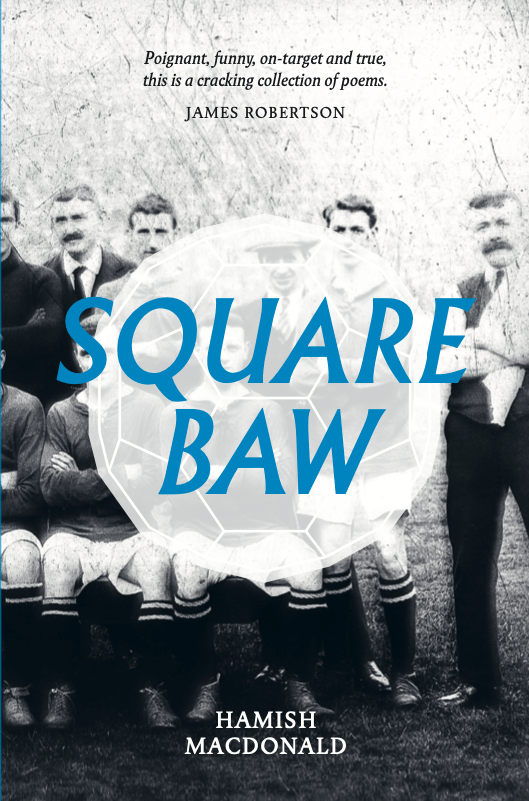
The new poetry collection includes Willie’s wartime and football story.
It plays out in the book’s 50 poems in Scots, organised into three sections – Part One: Fitba, Friends and Family; Part Two: William Grant’s War Journey; and Part Three: Mair Than A Gemme.
The title Square Baw is named after a football move, for anyone who doesn’t know their football.
“I had the title from the beginning when I thought about doing this collection.
“You hear it shouted regularly at games,” Hamish explained “When you pass the ball across the field to your team-mate, that’s a ‘square baw’. If you’re in a football crowd and someone is running with the ball and it looks as if it’s going to be a move, the crowd shouts ‘Square baw!’.”
Under the title, the book is described as “A Stramash o Scottish fitba poems” – a good Scots word regularly used by one-time TV Scotsport football commentator Arthur Montford and celebrated in Hamish’s poem In Praise Of Arthur Montford.
The subjects of the book’s poems go from Willie’s life to how Scotland stars in the history of football in It’s Comin Hame Ye Say!
You find what it’s like to be a fan – ups and downs, grounds, big games, the tongue-in-cheek glamour of The Kilbowie Brazilian and the international spread of fans as you find in A Clydebank Crest in Jamaica.
There are tender family football moments, such as a young Hamish and his dad in A Setterday Ritual or looking back to football’s consolation in depressing times in A Mid Life Crisis At The Gemme, Hamish imagining himself as an “Edward Munch face in the crowd”.
There are good times and bad times at football clubs, none more witty or funny or sad than the one spoken-word poem here from slam champion Hamish, Kilbowie Resurrection.

Hamish, the Bankies Bard – and pictured top – at the team’s Holm Park ground.
His first poem Turn On The Floodlights as Clydebank FC’s “Bankies Bard” commemorated the club now back, playing at Holm Park, after being homeless for a few years, with improvements, floodlights, new turf and terrace.
Hamish recalled: “The media rep David Brocket made a wee video with background music and stuck it up on Twitter and Facebook – 135,000 hits and 5,000 views on Facebook. Absolutely gobsmacked!”
In Square Baw, the powerful and embittered but hopeful poem Scottish Cup Safari is one big memory with Hamish’s home team “… resurrected, reimagined by fans”.
And adventures captured in the book include The Bankies March To Easter Road – “living the dream of a Scottish Cup odyssey” and Silver Jooblie at Wembley “ninety thoosan Scots gaun dementit”.
“Stories is a big part of football,” Hamish said. “I’m already a football poet and it seemed the logical way to approach what are essentially stories and poetry is a good medium for being able to flit in and out. The poetry gives you a freedom to be a bit more loose with it which I really like.”
Football makes a good subject for a collection of poems, it’s so wide. The book has won some great reviews, including from Scottish novelist James Robertson, who sums it up as: “Poignant, funny, on-target and true, this is a cracking collection of poems.”
Hamish said: “Before publication, folk were very generous and I was mindful that James Robertson wasn’t a football fan and I was curious what he would make of it, so I was delighted that, though not a football fan, he said he very much enjoyed it and it gave me a bit of reassurance.”
Hamish’s own passion for the game gives an edge and depth to the way he tackles his subject: “There are the highs and the lows of football – and it is people’s lives for better or worse – a national obsession, there’s no two ways about it!
“I think there is a more universal acceptance of football these days.
“Even kids’ football is much more accepting now than when I was a kid. Then, if you weren’t any good, you would just be rejected. Now more kids get a kick of the ball. There is walking football for people who are older. In many ways it is much more accepted by the broader community than it once was.”
Though Hamish still has some things to discover about his grandad’s life, he recalls him reciting The Goalkeeper’s Ghost poem at New Year parties. He knows he played at Hampden in front of 30,000 people, when many were away at war. He doesn’t yet know if Willie went back to the front later in the First World War. But it is interesting to hear that Willie’s role extended after being a player, later became a trainer and groundsman at Queen’s Park, as well as working as an engineer.
Hamish said: “What was magic about my grandfather was that he exemplified growing up and the early history of the game. He played for the Juniors, Queen’s Park, alongside one of Scotland’s greatest internationals (Alan Morton), he played Hampden, let alone served in the First World War.
“He played football and played an iconic part in battles he was engaged in.
“He seemed to characterise that whole world and made you think about your own football experiences, but also the whole Scottish game.
“The Scottish game to me is really idiosyncratic, it’s got all these fascinating aspects to it and as you get older, you realise how important it is to friendship and community.”
Remembering his own early football fan days as a child at Clydebank FC in his poems, Hamish said: “I wrote about the Singer’s factory, all the different buildings, the tenements, the shipyard cranes, and it all seemed quite monochrome. The buildings were all soot-eaten and there was industrial smog. It was a kind of damp place physically.
“You would have the hull coming up in the shipyards, but in the foreground there was this really colourful arena and spectacle.
“The green turf and the amber advertising hoardings and the players had quite a bright strip for its time in the 60s. It looked quite exotic. There was this splash of colour in the middle of the grey and dusty twilight.
“Thinking back to that period brings back, particularly if you grew up in an industrial community, that it is now post-industrial and a whole different world from what you knew as a kid growing up.
“Harking back to those days, not for nostalgic reasons, particularly, that period getting across the ferry to my granny and grandpa’s on a Sunday afternoon, the New Year parties when families lived locally, it draws you back in many ways to a time of settled and strong communities.
“We looked out for each other and I don’t mean that in a teary-eyed, rose-tinted kind of way. I just think it is important to remember those strengths.
“My parents and my grandparents were very left wing and great believers in trade unions and workers’ rights, tenants’ rights, citizens’ rights, and they were activists in their own way as well.
“That is something I take great pride in in being involved with Clydebank Football Club, the fact that it has been a community bringing it back.
“People pulled together for the common good. For me, it draws on that community strength exemplified by the generations before us.”
Square Baw: A Stramash o Scottish Fitba Poems by Hamish MacDonald is published in paperback by Scotland Street Press, £9.99. The book will be launched with Hamish reading on Wednesday, October 29 at La Tortilla Asesina, Inverness, from 7.30pm, in a joint book launch with Cynthia Rogerson whose new novel, 100,000 Birthdays is also out now. And there will be selling of the books and signing.
Hamish is also doing a talk at:
Bridge of Allan Library through the Scottish Book Trust with National Library of Scotland Scottish Scriever Taylor Dyson on Monday, November 17 from 2-3pm on the Scriever and Freens Tour. More details at scottishbooktrust.com
Hamish’s website is: hamishmacd.com
 So impress me